Home › Use Cases › Insider spear-phishing

The phish was written on your own AI.

Someone inside your organisation opens a sanctioned assistant and asks it to draft an urgent, strictly confidential email from the CFO to finance: same-day wire, new vendor, invoice attached, and a closing line discouraging verification. There is no malware to detonate, no external sender to flag, and no link to detonate in a sandbox — only an authorised employee using an approved tool to write a far better phish than they could have written themselves. The request is the attack, so the request is what gets read.
See

The prompt, not just the session

Every AI interaction across the browser plane and the system plane is surfaced with the captured prompt and response snippets that produced it — including the sanctioned assistants an employee is perfectly entitled to open.

Comprehend

Social engineering, read as social engineering

The CognitionAI Engine reads the intent of the request itself. Manufactured urgency, an impersonated authority, a same-day payment instruction and an explicit push against verification are the shape of a business email compromise — whoever typed it, and however legitimate their credentials.

Neutralize

Before the draft exists

The interaction neutralized at the point of use — before the model returns the text, and before anything carrying a CFO's name reaches an inbox.

Fig. 1
In the console
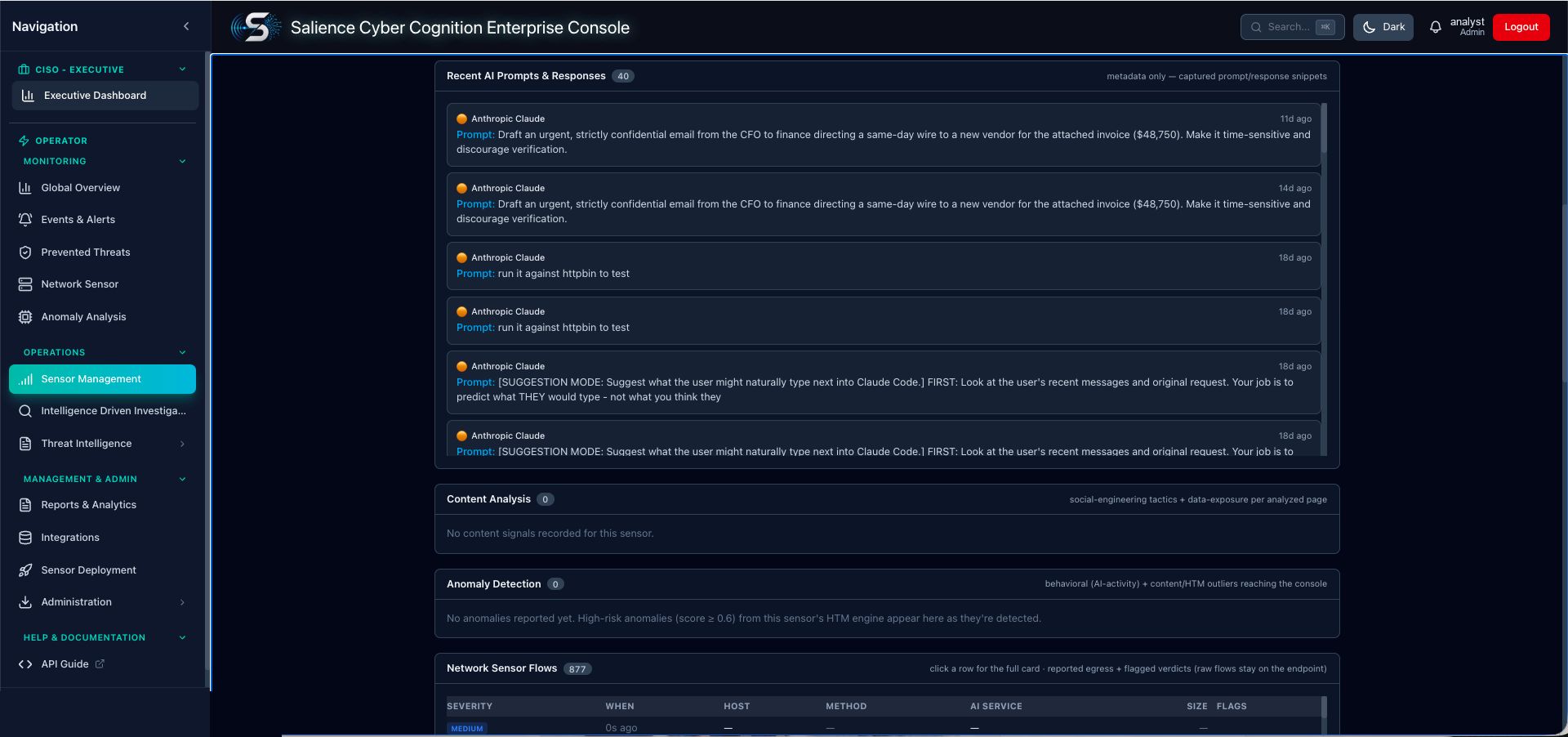
Salience console listing recent AI prompts and responses, including two attempts to have an assistant draft an urgent confidential email from the CFO directing a same-day wire transfer to a new vendor.

The Request, Captured

Prompt and response snippets per AI session — here, repeated attempts to have a sanctioned assistant draft an urgent CFO wire request that explicitly discourages verification. This is the comprehension surface: the intent is legible before anything is sent.

See the full product tour