See it. Understand it. Stop it — before it executes.
Observability across both AI data planes.Read the intent inside every interaction.Neutralize before it executes.
Your teams are using AI tools you can’t see
Prompts, tool calls, coding copilots, and autonomous agents — the AI your workforce adopted moves through a plane your security stack was never built to watch, let alone stop. The exposure is already inside your environment. You just can’t see it yet.
Your employees are using AI tools you can’t see. SalienceCyber.ai fixes that. It captures every AI interaction on the endpoint and turns it into one clean audit trail — visibility and enforcement in the same product, without an LLM sitting in the critical path or another EDR integration to maintain.
The exposure is measured, not asserted
Adoption outran governance. Attackers noticed. These are the figures from the 2026 breach data: what is ungoverned, what is being exploited, and how long anyone takes to notice.
All eight figures, with sources →
Sources
- [1] IBM Security, Cost of a Data Breach Report 2026, July 2026. Source for every figure marked [1]. ibm.com/reports/data-breach
- [2] IBM Newsroom, “One in Four Malicious Breaches are AI-Enabled, Costing Companies $6 Million on Average,” 29 July 2026. Source for the ~$6M average across the whole class of AI-enabled malicious breaches. newsroom.ibm.com
This is what seeing it looks like
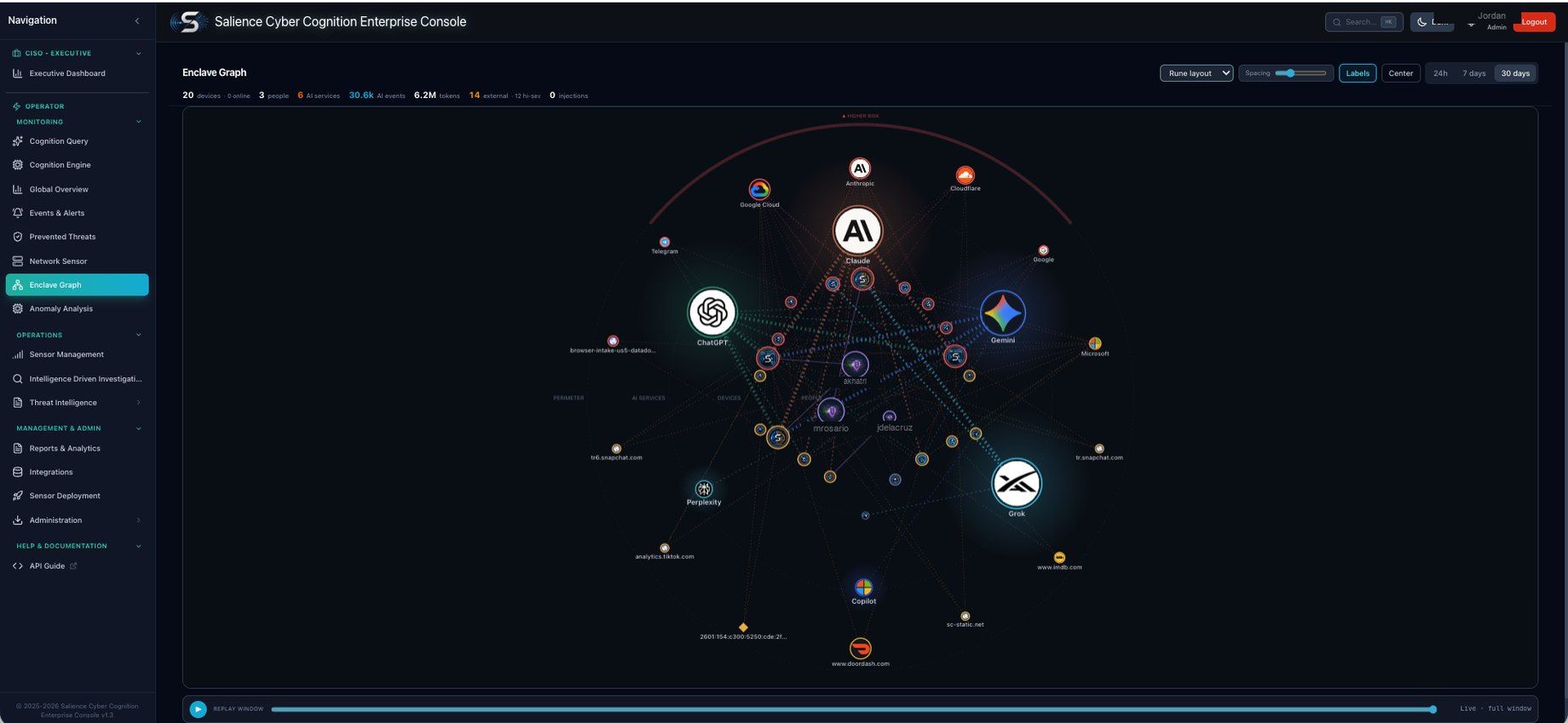
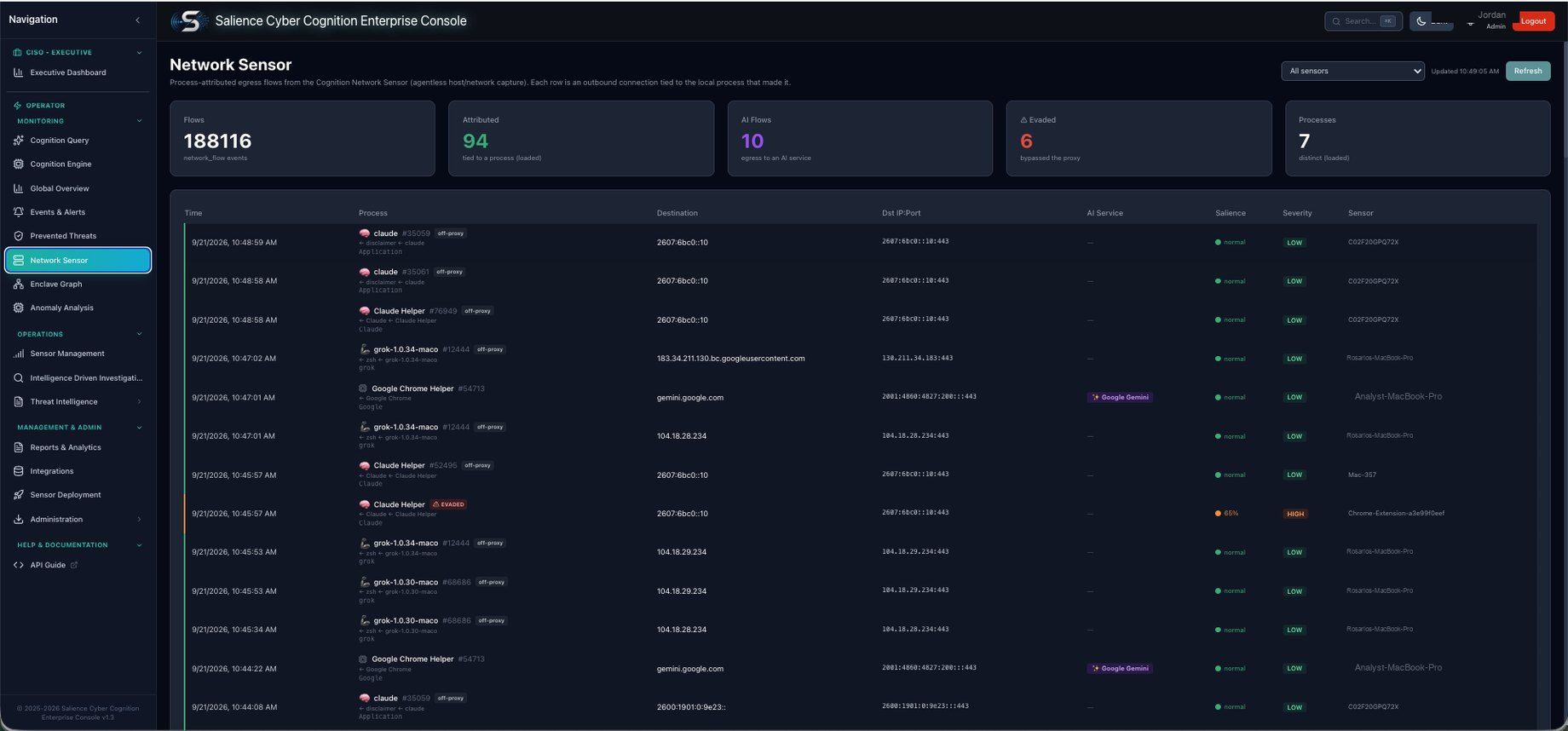
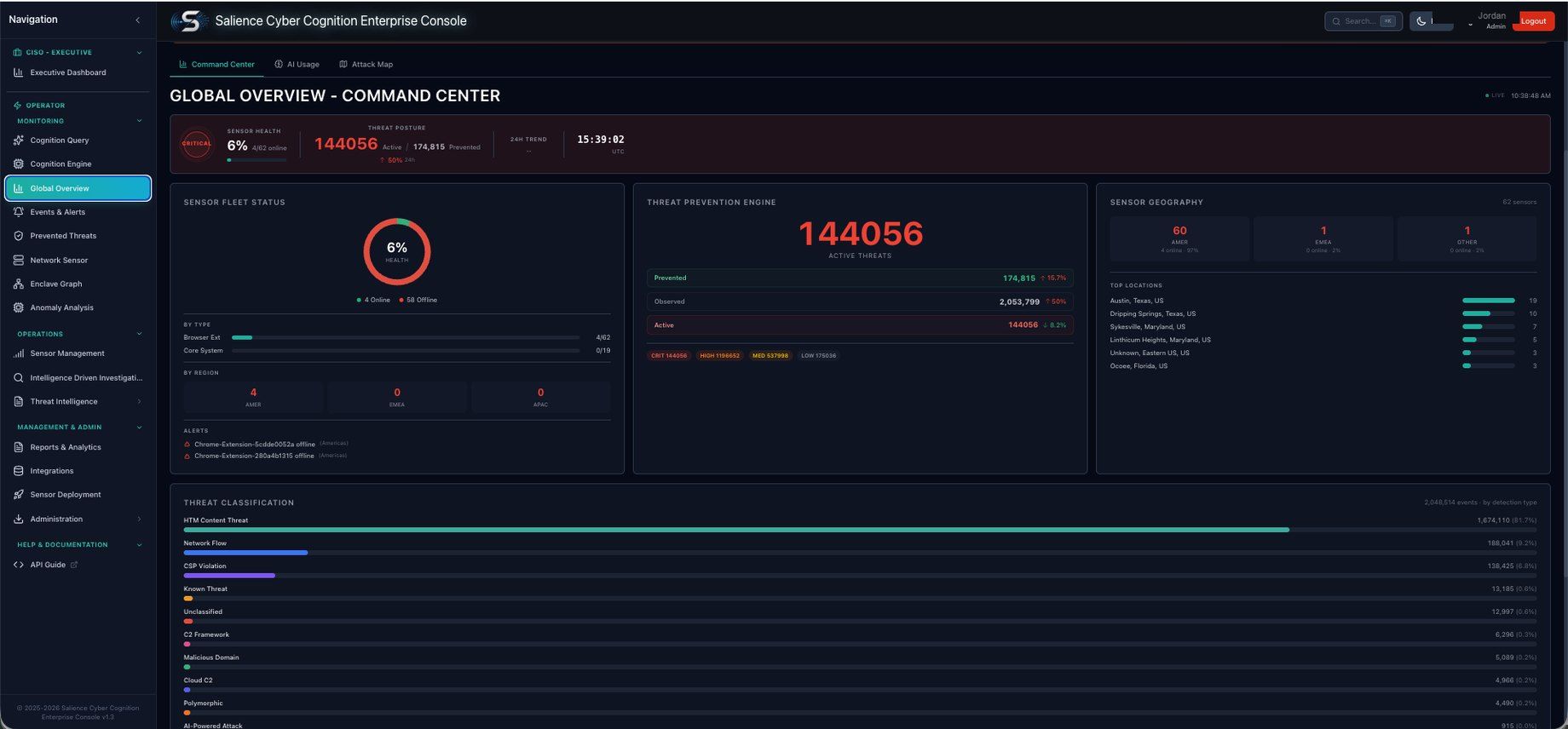
One platform, two data planes
SalienceCyber.ai watches AI activity in the browser and on the host, and can stop it in either. By combining an AI-aware browser extension with a lightweight System Sensor, organizations can See — Comprehend — Neutralize across every AI tool, GenAI session, and agentic workflow, and across both the host and browser data planes.
| One decision loopCognitionAI Engine | ||
|---|---|---|
| Browser planeBrowser Sensor | System planeSystem Sensor | |
| Where it runs | In the browser session, in-page | In userspace, on native OS APIs |
| What it reads | Prompts · GenAI sessions · tool calls | Processes · agents · AI-created artifacts |
| Kernel surface | None — the extension runs in-page, not on the host | None — no driver, kernel extension, EDR hook or Ring 0 |
| Platforms | Chrome · Chromium · Edge · Safari | Windows · macOS · Linux |
| Where it acts | At the point of interaction | At the point of execution |
The platform correlates AI activity across three key telemetry planes, under a single user, process, and session identity:
Intercepts and decodes AI-related network traffic to reveal model interactions, prompts, responses, and data movement.
Associates every AI connection with its originating process, and identifies applications attempting to bypass approved AI channels.
Tracks what AI accesses and what it creates — maintaining lineage even when AI-generated files or binaries are executed later, outside the original session.
Together, the host sensor and browser extension provide end-to-end visibility from user interaction to endpoint execution — one audit trail, with a named user and process behind every AI action, human or agentic, and no kernel-based monitoring to carry.
Explore the PlatformThe alert is the incumbent's business model.
See the CognitionAI Engine stop an AI-forged attack before it runs.
Request a Demo